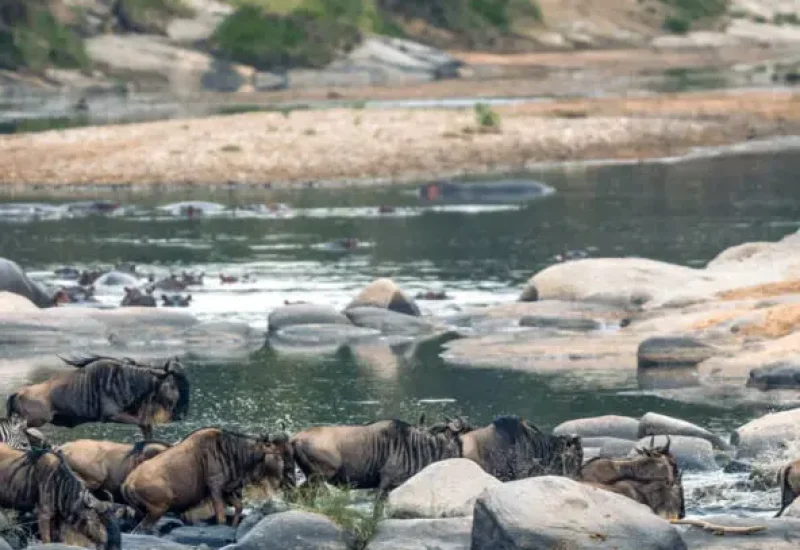
Great Migration in Serengeti is one of the most amazing wildlife experiences in the world. Every year, millions of wildebeest, zebras, and gazelles move across the plains of northern Tanzania in search of fresh grass and water. This journey happens all year round, with special moments like the calving season and the exciting river crossings. During a safari, you can see large herds, beautiful landscapes, and wild animals like lions and crocodiles. The Great Migration in Serengeti is a unique adventure and one of the best reasons to visit Tanzania.
The Great Migration in Serengeti is mainly caused by the search for food and water. Animals like wildebeest, zebras, and gazelles move in a natural cycle to find fresh grass after the rains.
When the rains fall in one area, new green grass grows, and the animals move there to feed. When the dry season starts and the grass finishes, they move again to another area where there is more food and water.
Rain patterns are the biggest reason for this movement. The animals follow the rain across the Serengeti and into Kenya’s Maasai Mara, then return again when the seasons change.
Another reason is survival and breeding. During certain times of the year, especially the calving season, the animals move to safer areas where they can give birth.
In simple terms, the Great Migration happens because animals are always moving to survive—looking for better food, water, and safe places to live.
The Great Migration in Serengeti National Park happens all year round, but animals move to different areas depending on the season.
January – March (South Serengeti / Ndutu area)
This is calving season. Thousands of wildebeest give birth in the southern plains. It’s a great time to see baby animals and predators like lions.
April – May (Central Serengeti)
The herds start moving north. This is the rainy season, and the park is green and less crowded.
June – July (Western Serengeti)
Animals move toward the western corridor. You may see river crossings at the Grumeti River.
July – October (North Serengeti)
This is the best time to see the famous river crossings at the Mara River as animals move between Tanzania and Kenya.
November – December (Return to South)
The herds start moving back to the southern Serengeti as the rains begin again.
During the Great Migration in Serengeti National Park, you will see a wide variety of wildlife, making it one of the most exciting safari experiences in the world.
These animals move together in large numbers:
Where there are many animals, predators are never far:
EXCELLENTVerified Dream Climb Made Possible by an Incredible Team Reaching the top of Mount Kilimanjaro was truly a once-in-a-lifetime experience, and I couldn’t have asked for a better team to guide me there. From day one, the agency was exceptionally organized and highly professional, which made the entire climb feel safe, smooth, and well planned.What really set them apart was the human side of the experience. Everyone—from the guides to the support team—was incredibly kind, warm, and genuinely caring. They created such a positive atmosphere every single day that even the toughest moments felt manageable.The food was outstanding, far beyond what I ever expected on a mountain trek—fresh, plentiful, and always a morale booster. And when it came to summit night, the guides were absolutely phenomenal: strong leaders, constant motivators, and deeply attentive, pushing us forward with encouragement exactly when we needed it most.Thanks to their expertise, energy, and heart, I stood on the roof of Africa feeling supported and proud. I would recommend this agency without hesitation to anyone dreaming of climbing Kilimanjaro. An unforgettable experience from start to summit!Posted onVerified Best trip ever Climbing Kilimanjaro with KiliSmile in cooperation with 4Challenge was one of the most powerful and unforgettable experiences of my life. The mountain was absolutely breathtaking, but what truly made the difference was the people.Our guide Gidion deserves a special mention. He didn’t just guide us up the mountain — he carried me mentally all the way to the summit. On the hardest days, when altitude and exhaustion kicked in, Gidion was calm, positive, and incredibly supportive. He is cool, safe, trustworthy, kind, and always cheerful, with an amazing ability to read people and know exactly when to motivate, encourage, or simply walk quietly next to you. His professionalism and experience made me feel safe at every single moment.The entire 40-person team was exceptional — from assistant guides to porters and the cooks. The food was surprisingly delicious and nutritious, always on time, and prepared with care even at high altitude. The team worked together like a well-oiled machine, always smiling, supportive, and deeply respectful.Thanks to this incredible team spirit and leadership, we made it to the top. It was not just a summit — it was a journey of trust, resilience, and human connection.If you’re considering Kilimanjaro, I can’t recommend KiliSmile & 4Challenge enough. And if you get the chance to climb with Gidion, you are in the best hands possible.Asante sana to the whole team — I will never forget this experience.Posted onVerified Non stop to the top From the very beginning, their team showed professionalism, attention to detail. They were making everyone feel safe and protected.The guides Hussain and Denis were extremly supportive and were motivating us tu achieve our goal. They ensured we felt safe and well-prepared all the time, every day during briefing after long hard day they were giving us hope but without minimazing the difficulties of the next day. The porters were our heroes, making this whole trekking unbelievebly luxurious. The portable toilet was bleesing during windy, cold nights. And I cannot even imagine going up without them. The meals were nutritious and tasty, and surprisingle diverse. Even though I was fighting with altitude sickness and dealing with lack of appetite, nausea and vomiting the cook and waiter and our guides were making sure that I eat something and were preparing something special for me. Especially worth mentionting is the magic of Hussain, Denis and Hasan during the worst moments doring the atack, when it's cold, windy and dark. You are fighting with your inner demons, loosing motivation. And then out of nowhere you hear your name in the song in swahilii, you doon't understand the words but you feel the warmth pulsing around your group and new strength coming to your body. It's spirituall and transcendental moment.I recommend KiliSmile from the bottom of my heart. They really make " One dream, One team" possible. And I am sure that without them I wouldn't achive the top.Posted onVerified Safari Experience We had a great experience! Our guide was awesome and very accommodating. His name was Sabas. The accommodation was very nice and had a pool, and the meals were great! Each day was so much fun, and our guide gave us lots of knowledgeable insight along the way.Posted onVerified Kilimanjaro, Safari, Ngorongoro, Serengetiti I have never experienced such openness, kindness, and care as I did during my Kilimanjaro trip organized by KiliSmile. I’m incredibly grateful to Hashim, who looked after me and motivated me whenever I felt weak or tired. Hashim always watching over everyone, ready to help the moment someone felt unwell, exhausted, or started doubting themselves.Throughout the climb, Ayoub, Hashim, and the rest of the team showed great experience and awareness, giving me and the other participants a strong sense of safety and calm. Ayoub and his crew are wonderful, cheerful people who never showed any fatigue — they were always full of energy, smiles, and songs that kept us motivated all the way.During the trip to Ngorongoro and Serengeti, I was lucky to be in the car driven by the best driver in all of Tanzania — Lucas. With his warm smile, Lucas shared many stories, always knew the perfect spot to park for the best view of the animals, and kindly answered all our questions.KiliSmile is truly special because of the exceptional people who work there. Everyone I met went above and beyond all expectations with their passion and dedication!I will definitely return to Tanzania — it’s an extraordinary, magical place filled with amazing people! ???????????????? Hakuna matata ????????????????Posted onVerified Kilimanjaro with Kilismile It was my first visit in Africa and thanks to Kilismile I didn’t need to worry about anything. I spent amazing time with caring, wonderful team and could fully enjoy beautiful area. Food was delicious, people always helpful and friendly. It was nothing missing. Thanks!Posted onVerified Guides and Porters Who Made Us Feel Like Family We had the most unforgettable adventure climbing Kilimanjaro with Kili Smile Agency! From start to finish, everything was perfectly organized and we felt safe, supported, and inspired every step of the way.Our guides Denis and Rajabu (Roger) were incredible – professional, knowledgeable, and always attentive to how we were feeling. They paced us perfectly, motivated us when the climb got tough, and shared so much about the mountain, the culture, and the local wildlife. Thanks to them, reaching the summit was not just possible, but truly enjoyable.A huge thank you also goes to our amazing porters – Juma, Baraka, and Joseph. Their strength, kindness, and good humor made the whole journey lighter (literally and emotionally!). They carried heavy loads with a smile, prepared camp so quickly and efficiently, and always had a kind word of encouragement.If you want to climb Kilimanjaro with a team that feels like family and truly cares about your experience, look no further than Kili Smile Agency. We couldn’t recommend them more!Posted onVerified Kilimanjaro experience at its best! Conquering Kilimanjaro was one of my biggest dreams, and I managed to achieve it thanks to the Kilismile agency. I can definitely recommend their services to anyone planning this incredible expedition.From the very beginning, I felt like I was in good hands. The entire Kilismile team, from the guides to the porters and all the support staff were incredibly professional, yet also very kind and helpful. I especially want to commend the experienced guides, who not only knew the route perfectly but also looked after my safety every step of the way. Their support and valuable advice were priceless, especially since I had zero experience in high-altitude trekking.I also have to mention the cook, who deserves a special shout-out. After each day on the trail, delicious, warm meals were waiting for me, which gave me the strength and energy to continue the climb. This is a huge plus when you're tired and need proper, nutritious food.Huge respect also goes to the porters. Their hard work and smiles on their faces, despite the enormous effort, deserve the greatest admiration.Thanks to the entire Kilismile team, I felt safe and comfortable throughout the whole journey. It was their support and positive energy that allowed me to reach the summit. If you're looking for a professional agency that will make your Kilimanjaro climb an unforgettable and safe adventure, Kilismile is an excellent choice!Posted onVerified Incredible Experience and Lovely people ???? Climbing Kilimanjaro with KiliSmile was an unforgettable experience! The guides were professional and motivating, the porters hardworking and always smiling, and the food was delicious even at high altitude. The whole team created a warm, supportive atmosphere that made the journey safe, well-organized, and truly special. Highly recommend KiliSmile to anyone dreaming of reaching the summit!Posted onVerified Special thanks A wonderful team, wonderful people. Perfectly organized trek, helpful people, they know what to do in every situation... from lost equipment during the flight, through illnesses and moments of breakdown. They know how to find the right words... The biggest thanks to Rajabu. He helped me in everything, thanks to Rajabu I reached Stella Point, despite all the difficulties.